


Bible Study Series on the Book of Nehemiah
Nehemiah Chapter 2: The Reproach, the Rock & the Rubble
by I Gordon
Neh 2:1-8 And it came about in the month Nisan, in the twentieth year of King Artaxerxes, that wine was before him, and I took up the wine and gave it to the king. Now I had not been sad in his presence. So the king said to me, 'Why is your face sad though you are not sick? This is nothing but sadness of heart.' Then I was very much afraid. And I said to the king, 'If it please the king, and if your servant has found favor before you, send me to Judah, to the city of my fathers' tombs, that I may rebuild it.' ...And the king granted them to me because the good hand of my God was on me.
Neh 2:9-20 So I came to Jerusalem and was there three days... So I went out at night by the Valley Gate in the direction of the Dragon's Well and on to the Refuse Gate, inspecting the walls of Jerusalem, which were broken down, and its gates, which were consumed by fire. Then I passed on to the Fountain Gate and the King's Pool, but there was no place for my mount to pass...Then I said to them, 'You see the bad situation we are in, that Jerusalem is desolate and its gates burned by fire. Come, let us rebuild the wall of Jerusalem that we may no longer be a reproach...' Then they said, 'Let us arise and build.' So they put their hands to the good work. But when Sanballat the Horonite, and Tobiah the Ammonite official, and Geshem the Arab heard it, they mocked us and despised us and said, 'What is this thing you are doing? Are you rebelling against the king?' So I answered them and said to them, 'The God of heaven will give us success; therefore we His servants will arise and build, but you have no portion, right, or memorial in Jerusalem.'
The Reproach : (
Neh 2:17 '...Come, let us rebuild the wall of Jerusalem that we may no longer be a reproach...'
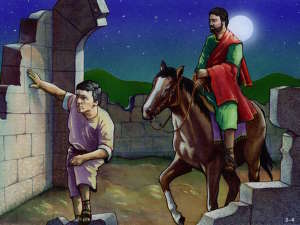 Having been granted favour and leave by the Persian King, we read in chapter 2:11-18 of Nehemiah's first inspection of Jerusalem. For three days he saw the situation first hand and could see the devastation and destruction of Gods city. After the inspection, again we are told, "You can see the situation we are in, that Jerusalem is desolate and its gates burned with fire. Come, let us rebuild the wall of Jerusalem that we may no longer be a reproach." (vs 17) Why were they a reproach while in that condition? Again, because faced with enemies on every side who had their own gods, Jerusalem alone stood for the city of the true God. They were the people of God. Of all the nations, they alone had been adopted into Gods family (Ex 4:22), given the promises and covenants (Gen 12, Gen 15, 2 Sam 7:12-16). It was this thought I believe that saddened Nehemiah before the king earlier in the chapter, for we read, "Why should my face not be sad when the city, the place of my fathers' tombs, lies desolate and its gates have been consumed by fire?" (Ch 2:3) As he remembered Israel's fathers, Abraham, Isaac, and Jacob, and how it all began - the faith of the patriarchs, the miraculous interventions of God, the promises and the glorious position they gave... And Israel now, its city destroyed, its people exiled and its God silent - a reproach to the name of their God.
The parallel of course, seems to fit with the people of God today, the church. With the wall that separates us from the world being taken apart brick by brick, many in the western church don't seem to know the difference between godliness and worldliness anymore. Like Nehemiah, our thoughts go back to how it all began where "they continually devoted themselves to the apostles' teaching and to fellowship, to the breaking of bread and to prayer. Everyone kept feeling a sense of awe and many wonders and signs were taking place through the apostles. And all those who had believed were together and had all things in common ... praising God and having favour with all the people. And the Lord was adding to their numbers daily those that were being saved." (Acts 2:42-47). The question must be asked - Is the Laodicean1 Church that we see in the west today, any better off today than Israel was in Nehemiah's day?
The Rock Of Our Foundation!
Neh 2:13 'Then I passed on to the Fountain Gate and the King's Pool, but there was no place for my mount to pass...'
Enough moaning. What was the solution? What had to happen first? We read that when Nehemiah inspected the wall he "passed on to the Fountain Gate and the King's Pool, but there was no place for my mount to pass." (vs 13) In other words, the rubble from the smashed stonewalls was so high that he couldn't get past. Obviously, the first thing that had to happen if any restoration was going to take place was to get rid of this stinking rubbish! They had to get back to the cities foundation. There is no way that they would have tried to build a wall on top of a huge mound of broken stones. Not very smart, not very secure! No, they had to get rid of the rubble cause it was preventing a solid wall of protection from being built, and it clogged up the gates denying the people of God access into his presence.
No prizes for guessing what foundation they had to get back to. "According to the grace of God which was given to me, like a wise master builder I laid a foundation, and another is building on it. But each man must be careful how he builds on it. For no man can lay a foundation other than the one that is laid, which is Jesus Christ." (1 Cor 3:10-11) The only foundation given in the word is Jesus himself , and any work built upon any other foundation will always end in how Jerusalem is pictured here - rubble! Years of hard work had gone into Jerusalem's walls and it had all come to nothing. Jesus' death on the cross and resurrection from the dead gives us both the foundation and the means by which we can actually begin building our lives (or the church). The bible tells of those who remain spiritual babies being "tossed here and there by waves and carried about by every wind of doctrine" because they are "not accustomed to the word of righteousness..." (Eph 4.14, Heb 5:13). They have little protection because they still don't understand the foundation that Jesus himself is their righteousness. They don't understand the implications of his death, so can never progress onto his resurrection.
 What will you build on?
In recent times however, other builders have told us that they have found a new type of foundation upon which you can build very successfully. A very old builder called Geshem said that money and worldly success laid a great foundation to build on. I think he added that God wants you to be rich. The builder Tobiah recently said that good works were the way to go (actually many builders have tried to use this for years). He also stated that some magnificent buildings had been made on this foundation once the builder had increased their effort, cleaned every spot off their garment and were up to date confessing every bad thought and deed. Do this and he guarantees it will work. Well, we'll see later what became of this builder. But in the meantime some still prefer that old foundation being "built on the foundation of the apostles and prophets, Christ Jesus himself being the corner stone, in whom the whole building, being fitted together, is growing into a holy temple in the Lord." (Eph 2:20-21)
Clear That There Rubble!
Neh 2:18 'Then they said, 'Let us arise and build.' So they put their hands to the good work.'
So, we know what the foundation is, but how do we get to it? Who wants to be a rubbish removal man? Not a very nice job. For the saved individual who has just seen how desolate his life is, and has prayed in faith based on the promises of God, there is a new life awaiting him. But it involves a new way of thinking and a clearing out of the rubbish that would seek to bind him to his old life. This rubbish is simply the remains of your own attempt to build your life independent of God. It may be your worldly thoughts and attitudes or maybe something of your past associations with Sanballat as in Acts 19:19 where "those who practised magic brought their books together and began burning them in the sight of everyone."
For the church as a whole the rubbish is obviously more public and therefore the removal of it causes a bigger stink. There are always a lot of people who want to build the walls of the church, but not a lot who are brave enough to suggest that there is a heck of a lot of rubble, and rubble can't be built on! It was even discouraging in Nehemiah's day, as in Judah it was said "The strength of the burden bearers is failing, yet there is much rubbish and we ourselves are unable to build the wall." (Chapter 4:10). It's not a very rewarding job clearing rubbish! You could have asked Dave Hunt back in his day (he is now with the Lord) and others that do that role today. But at least in Nehemiah's day they knew that they had to remove the rubbish before they could build on a solid foundation. We just seem to carry on building as if everything is fine and then watch it topple over! And surprised that God didn't come through or allow it to stand, we then double our efforts and find, like Israel travelling in circles throughout the wilderness, that more effort only brings you back to where you began quicker! Surely all the calls stating that the next great revival is just around the corner are not taking the current rubble into account. No, Nehemiah did it right. See the depth of the problem, cry out to God, get rid of the rubbish, build and restore glory to Gods name on the only foundation worth mentioning - Jesus.
The Rubbish Removal Man's Arch Nemesis
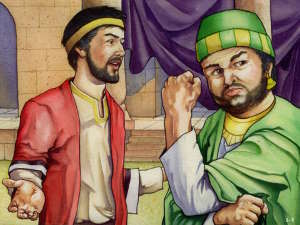 Neh 2:19 'But when Sanballat the Horonite, and Tobiah the Ammonite official, and Geshem the Arab heard it, they mocked us and despised us and said, 'What is this thing you are doing? Are you rebelling against the king?' '
Not everyone likes rubbish removal men it seems. We see here the three great enemies that will combat Nehemiah continually in his mission to rebuild the walls of Jerusalem. And it is these three enemies we face when we determine to turn and follow God whole-heartedly. The rest of my Nehemiah study will focus on these three characters but for now lets just look at how Nehemiah responded to them. Faced with the mockery of Sanballat, Tobiah and Geshem he told them " The God of heaven will give us success; therefore we his servants will arise and build, but you have no portion, right or memorial in Jerusalem." (Ch 2:20).
Yes, the God of Heaven will grant success over these enemies when we turn and trust in Him.
And it is also true that nothing of the old creation will remain in the New Jerusalem!.2 That is a day I look forward to... but for now there is a battle as we shall see in the remaining part of this series.
FOOTNOTES
[1] Laodicea mean 'the peoples opinions'. And that is what we commonly see today unfortunately.
↩
[2] Thankfully, nothing will. This statement of Nehemiah for the Jerusalem that he was going to rebuild is true of all Christians today even though we don't always see it. From Gods perspective we were associated with the death and resurrection of Jesus and he will never ever see us independent of the work of his son again. From Gods perspective the sinful nature died at Calvary (Rom 6:6), and all that remains is the new creation (2Cor 5:17). That new creation is hid in God and as safe as can be. (Col 3.3-4). Satan was defeated at the cross (Col 2:13-15) and even the world can't influence the new creation which is already 'seated in heavenly places' (Eph 2:6) The final fulfilment of this verse however, is in the age to come for all three enemies will have no portion or right in the New Jerusalem (Rev 21:27 'nothing unclean... shall ever come into it, but only those whose names are written in the lamb's book of life). Nor shall there be any memorials in the New Jerusalem for 'the former things shall not come to mind.'
↩
ACKNOWLEDGEMENTS
Images designed by Tim Shirey/Suzanne Peavy and used under the Creative Commons International License. © Child Evangelism Fellowship Europe