


Bible Study Series on the Book of Nehemiah
The Christian's Life and Warfare
by I Gordon
Background to the Book.
The book of Nehemiah was written by, wait for it, Nehemiah, between 445-425 BC. Along side Ezra, it records the fulfilment of God's promise to restore Israel to her land after the 70-year exile in Babylon. The warnings to Israel as a nation had been around for some time but they came to a head in 605 BC where the prophet Jeremiah spoke to the nation as is recorded in Jeremiah 25:1-12:
So Jeremiah the prophet said to all the people of Judah and to all those living in Jerusalem: 'For twenty-three years - from the thirteenth year of Josiah son of Amon king of Judah until this very day - the word of the LORD has come to me and I have spoken to you again and again, but you have not listened. And though the LORD has sent all his servants the prophets to you again and again, you have not listened or paid any attention... Therefore the LORD Almighty says this: 'Because you have not listened to my words, I will summon all the peoples of the north and my servant Nebuchadnezzar king of Babylon,' declares the LORD, 'and I will bring them against this land and its inhabitants and against all the surrounding nations... This whole country will become a desolate wasteland, and these nations will serve the king of Babylon seventy years. But when the seventy years are fulfilled, I will punish the king of Babylon and his nation, the land of the Babylonians, for their guilt,' declares the LORD.'
History records that in 586 BC this came about exactly as Jeremiah had predicted and for the next 70 years the people of Israel and Judah were in exile and their beloved city, Jerusalem, was destroyed. After this period, some of the exiles returned to Jerusalem, but being a city without walls or protection, the Jewish remnant were always at the mercy of their ever-present enemies. The book of Nehemiah starts then, with this as its background.
The Types and Players in Nehemiah
This study is not about history however. It's about today and our Christian life. I believe the Holy Spirit has placed within this book key characters and events that reveal to us today the basis of our walk and warfare as Christians. I looked up a commentary on this book and it stated that it was a useful book for 'building projects and leadership skills'. Sorry but none of that interests me so you won't find it here. What you will find however are important steps that this book teaches us in how to overcome our three deadly enemies - Satan, the world and our old sinful nature. The basis of this study then, revolves around certain key individuals, their character, and the work that they were attempting to do. Obviously, the main character is Nehemiah himself, whose job it was to rebuild the wall and its gates. While he had many enemies, the three most prominent were Sanballat, Tobiah, and Geshem. So to understand what this book is about, and especially how it could possibly relate to us today, we have to start by defining these key components first.
The Wall
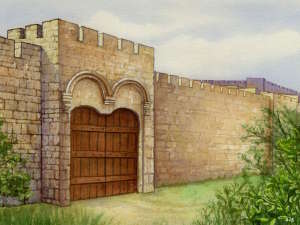 No surprises here. In the natural sense, the wall surrounded Jerusalem, and was broken only by 10 gates. The wall kept the wrong people out, while the gates let the right people in. The walls were for protection and showed the separation between the people of God, and His enemies. The walls represent our salvation, specifically from the power of sin. This is stated clearly in Isaiah 60:18, which states, "But you will call your walls salvation and your gates praise." Throughout the OT, the walls represented both the whole nation of Israel as well as individuals. An example of the former is where King David prayed, "By your favour do good to Zion, build the walls of Jerusalem" (Psalm 51:18). King Solomon stated the later when he wrote, "Like a city that is broken into and without walls, so is a man who has no control over his spirit." (Proverbs 25.28)
Therefore the rebuilding of the walls can speak to us of our own individual lives or as Gods people today, his body, the church. And while most of this study is for the individual, both aspects will be looked at.
The Gates
The gates represent entrance into the Lord's presence and the experiences of the Lord that the righteous will enter into. This will be examined in chapter 3 of Nehemiah but for now just a few quick quotes concerning gates:
Isaiah 26:1-2 "He sets walls... for security (salvation). Open the gates that the righteous may enter, the one that remains faithful."
Psalm 100:4 "Enter his gates with thanksgiving..."
Jesus himself is the only way by which we can enter into the presence of God, so it is no surprise that he said
John 10:7 "Truly, I say to you, I am the gate for the sheep...if anyone enters through me he will be saved, and will go in and out and find pasture."
Nehemiah
I believe that a 'big picture' survey of this book shows that Nehemiah is a type of the Lord Jesus Christ. The one who gave up his position with the Father to restore and rebuild our lives. Nehemiah's name means 'Yahweh consoles' or 'Yahweh comforts' and that certainly is what Jesus is to us. I will try to point out in the study when and where he is a type of the Lord. One thing is sure and that is in all that he does, we see the attitude and action of a man alive to God. One that is spiritually reborn and living by that Spirit. And then we have the 'baddies'!
Sanballat
The name "Sanballat" means "Hatred in secret". Lovely name! In the study to come we shall see that he is the main man behind most of the attacks. He was very wealthy, and had a lot of influence, power and control. As we shall see, he stands for our biggest enemy, Satan, the hater of Gods people.
Geshem
The name Geshem means "Corporealness", which, cause I didn't know, means "Physical, tangible, material, bodily". The second enemy then speaks of the world! - That which is physical, tangible etc. He might not be mentioned much, but his form of warfare against Nehemiah is very subtle indeed, and is used when others have failed.
Tobiah
The name Tobiah means, "Jehovah is good". A strange name indeed for someone who so vigorously opposes Jehovah's chosen people! In all of his operations Tobiah will clearly show himself to be our third enemy, Old Adam, the flesh. Tobiah speaks of the sinful nature that not only does bad, but has a great tendency to also do good! (And, as we shall see, he will trick a large percentage of Gods people through this means!)
Nehemiah Chapter 1: Understanding the nature of the fall
Neh 1:1-3 - The words of Nehemiah the son of Hacaliah. Now it happened in the month Chislev, in the twentieth year, while I was in Susa the capitol, that Hanani, one of my brothers, and some men from Judah came; and I asked them concerning the Jews who had escaped and had survived the captivity, and about Jerusalem. And they said to me, 'The remnant there in the province who survived the captivity are in great distress and reproach, and the wall of Jerusalem is broken down and its gates are burned with fire.'
The book of Nehemiah begins then, where any true salvation or revival has to start - with a realisation of your spiritual condition. Nehemiah1, asking of the Jews, and of Jerusalem's condition was told, "The remnant there in the province who survived the captivity are in great distress and reproach, and the wall of Jerusalem is broken down and its gates are burned with fire." Lets pause for a moment and think of what this picture means. Out of the whole world, God had chosen but one nation - Israel. This nation was chosen to be his people, display his glory and bring understanding and light to the other nations of the world. The rest of the world was, and is, as John tells us "in the power of the evil one." (1 John 5.19). The whole world was in spiritual darkness, blinded by the god of this age. (2 Cor 4.4) Their only hope came in the form of a small nation called Israel, who alone had the knowledge of the true God. And this nation was now completely destroyed! Broken and burnt to the ground, there now remained no walls of salvation, no gates to enter Gods presence and no visible sign of the living God on earth! It was Satan's day as the entire world was in his control.
This scenario speaks of more than just Jerusalem 2500 years ago. It speaks to us today of our own state, both to those who have not known the Lord and to those who have become Christians, yet who have let their walls of salvation get broken down and now find themselves in this same distressed state. We will examine this further later on, but for now I would just like to draw your attention to the depths of the fall of mankind and the predicament in which the world is left in.
Driven to Prayer
Neh 1:4 Now it came about when I heard these words, I sat down and wept and mourned for days; and I was fasting and praying before the God of heaven.
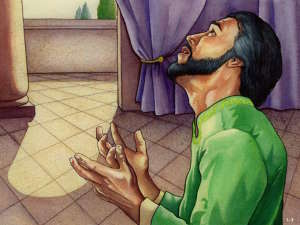 We have seen earlier that it starts with a realization of your actual condition. It progresses on here to action concerning that condition. When Nehemiah learnt of the true state of Jerusalem he "sat down and wept and mourned for days." The picture is of a man coming to God on Gods terms. Not for money, power, or the latest buzz, but for forgiveness and the restoration of life. Not offering God his good works as if that could impress God, but with repentance and faith in the character of God, he sought God that this condition would not remain! Also note here that God is called 'the God of Heaven'. In earlier times, God had been called 'the God of heaven and the God of earth' (Gen 24:3). Not now. Nehemiah was honest in seeing that because of the state of His people, God no longer had a visible witness on earth.
Neh 1:5-11 And I said, 'I beseech Thee, O Lord God of heaven, the great and awesome God, who preserves the covenant and loving kindness for those who love Him and keep His commandments, let your ear now be attentive and your eyes open to hear the prayer of your servant which I am praying before you now, day and night, on behalf of the sons of Israel Your servants, confessing the sins of the sons of Israel which we have sinned against you; I and my father's house have sinned. 'We have acted very corruptly against you and have not kept the commandments, or the statutes, or the ordinances, which you did command, Thy servant Moses. 'Remember the word which Thou didst command your servant Moses, saying, 'If you are unfaithful I will scatter you among the peoples; but if you return to Me and keep My commandments and do them, though those of you who have been scattered were in the most remote part of the heavens, I will gather them from there and will bring them to the place where I have chosen to cause My name to dwell.' 'And they are Thy servants and Thy people whom you did redeem by your great power and by your strong hand. 'O Lord, I beseech Thee, may your ear be attentive to the prayer of your servant and the prayer of your servants who delight to revere your name, and make your servant successful today, and grant him compassion before this man.' Now I was the cupbearer to the king.
Verses 5-11 give us Nehemiah's prayer and it is very interesting to read an example of a godly prayer at a time like this. Nehemiah begins in verse 5 by reminding God of both His character and covenant promises to Israel if they loved Him. He then correctly confesses their sins as a nation, not in any way trying to hide from the fact that they have bought this upon themselves. In verse 8 he again reminds God of His promise to restore Israel if they returned to Him and in verse 10 he states that Israel are God's people whom he has so faithfully redeemed and protected in the past. Overall, it is a prayer of repentance based entirely on the promises, purposes, and faithfulness of God as they turn once again to Him.
Nehemiah himself, we are told, was "the cupbearer to the king." (vs 11) This was a very important position, as he would taste the Kings wine to make sure it was not poisoned. He was therefore a trusted and close ally to the king. Nehemiah however, was willing to leave this position and like Moses before him "choose to endure the ill-treatment with the people of God than to enjoy the passing pleasures of sin, considering the reproach of Christ greater that the treasures of Egypt." Heb 12:25-26).
Nehemiah thought more for God's people and the restoration of Gods glory than he did for himself. This should be our attitude. This action of course, is but a small picture of him who "though he were rich, yet for our sake became poor, so that through his poverty we might become rich" (2Cor 8:9) 2
FOOTNOTES
[1] Nehemiah means 'the comfort of Jehovah'. His father Hacaliah means 'waiting on Jehovah'. Isn't it interesting how much meaning there is in their names? Hacaliah would probably have lived his whole life in exile, with Jerusalem destroyed and Israel in a state of despair. Truly he would have been 'waiting on Jehovah'. When his son was born he called him 'the comfort of Jehovah' and Nehemiah would grow and truly become that to his people Israel.
↩
[2] There's more to this than I first thought. What I've just written about the attitude needed in becoming a Christian is one aspect, but there's a bigger picture lurking here! I've just read a little more about being a cupbearer. The cupbearer was situated at the right hand of the king and had to drink the cup of the king to check for poison. Obviously, 'checking for poison' meant being willing to give up his own life for the king's sake. Nehemiah is a picture of Jesus Christ! It was Jesus, who being situated at the right hand of God, was willing to give up his life for the sake of the Father. Did he not know the consequences of the cup he had to drink? We read in Matt 26:38-39 'My soul is deeply grieved, to the point of death;... My Father, if it is possible, let this cup pass from me; yet not as I will, but as you will.' Like Nehemiah coming to Jerusalem, Jesus had to leave the Father for this cup to be drunk. And yet through it, the walls of salvation would be built and ALL enemies would be defeated!
↩
ACKNOWLEDGEMENTS
Images designed by Tim Shirey/Suzanne Peavy and used under the Creative Commons International License. © Child Evangelism Fellowship Europe